.png)
.png)
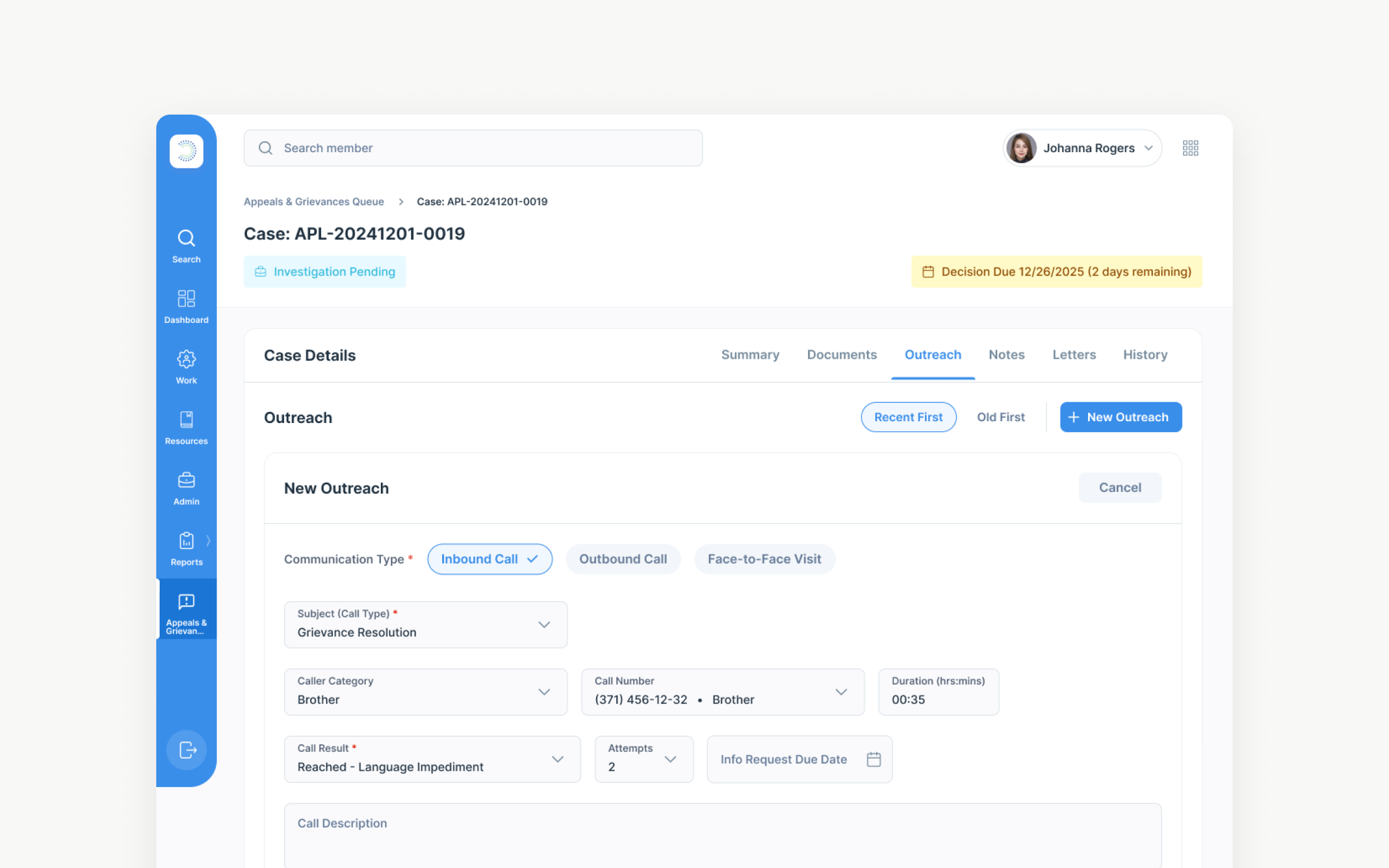
Our team was tasked with creating a rapid prototype of a clinical Appeals and Grievances (A&G) platform with a 3 day turnaround. An opportunity to demo to the decision maker of a large hospital system was on the table. While we had clinical expertise, adjacent products and technical development skill, the proposed platform was nowhere in our existing roadmap.
I led the design process to create an interactive A&G prototype under a highly constrained time frame using Claude Design.
A prototype built for a sales conversation carries a different burden than one built for validation. It has to be plausible to someone who runs this workflow for a living — which means the domain logic has to be right even where the pixels are provisional.
Appeals and Grievances is the escalation path a member takes when disputing a coverage decision. Cases are set against regulatory guidelines and CMS turnaround deadlines. Given the regulatory constraints, it was vital that we leaned on SME input to accurately calculate case expiry and when to surface dormant or priority items.
SME interviews with Nurse Reviewers, Nurse Managers, and Care Coordinators informed the A&G workflow — intake, clinical review, determination, escalation paths and NCQA requirements around response times. These insights became the BRD.
A BRD paired with a flow chart and the design system provided three essential inputs for the AI prompt: what the product needed to do, how a case moves through it, and how to draft a UI in alignment with existing products' look and feel.
Claude Design built the flows and applied the design system with high fidelity, producing working screens in a fraction of the time a manual first pass would have taken. The team found bugs within the tab functionality but were still able to use the code provided by Claude Design as a jump point. Developers were able to focus their time on specific, complex engineering problems instead of investing a large portion of their bandwidth to get basic functions up and running.
When it came to interaction design, some manual reconciliation in Figma was required to close the gap between the Claude Design output and the established system design of the company's existing Care Management and Utilization Management platforms. The components were correct; the behaviors weren't always — inline forms where our platforms use modals, and similar mismatches. Within Figma, I manually created screens that aligned with the existing system design and passed it to dev for implementation into the prototype.
The learning: a design system alone is not enough input for AI-assisted implementation. To create high fidelity outputs that match both UI components and interaction design, authoring interaction guidelines the AI could reference ("Skills" in Claude Design) was a necessary step to avoid manual adjustments on the backend. Consistency across a product suite lives in interaction and system design documentation — and if that documentation doesn't exist, the AI will invent something reasonable and wrong. When it comes to prototyping with AI, I now treat that documentation as a required deliverable, not a nice-to-have.
The prototype was completed in time for the sales demo and led to a contract which funded the formal build of the Appeals and Grievances platform.
.png)
.png)